Where the Wild Still Runs Free
There are photographs you plan for, and then there are photographs that simply happen in front of you.
This was one of those moments.
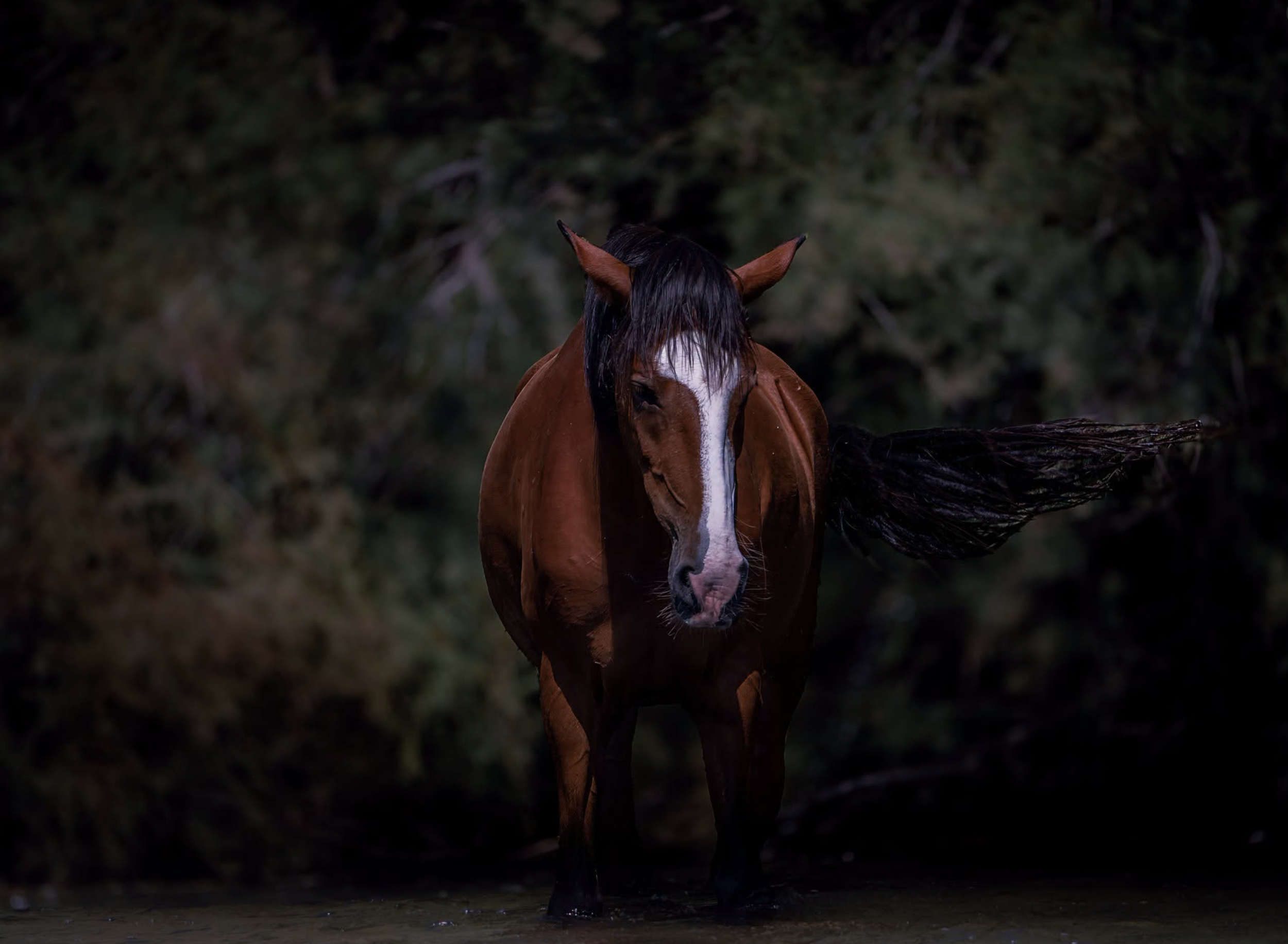
Standing quietly in the water, surrounded by the deep shadows and tangled vegetation along the river, this wild horse seemed to emerge from the darkness. The light found just enough of him to reveal the rich brown of his coat, the white blaze running down his face, and the water still clinging to his body.
Then there was the mane and tail.
Wet, heavy, and swept to the side, they told part of the story that a still photograph cannot completely explain. This horse hadn't been standing around waiting for someone with a camera. He was moving through his world, using the river, navigating the heat, the brush, the mud, and everything else that comes with surviving in the Arizona desert.
That is one of the things I find so fascinating about photographing wild horses.
Beauty Is Only Part of the Story
When people see photographs of Arizona's wild horses, it is easy to focus on the beauty of the scene. The river, the horses, the desert mountains and the Arizona light can create something that almost doesn't look real.
But these horses don't live inside a postcard.
Their world can be unforgiving.
Summer temperatures climb well into the triple digits. Water and food can become scarce. The terrain can be rough. There are injuries, competition within the herd, changing river conditions and the constant demands of simply finding enough food and water to make it through another day.
The river may look peaceful through my camera, but for the horses that depend on it, it is part of survival.
That is what I see when I look at this photograph.
I see strength.
I see an animal completely adapted to the world around him.
And I see a reminder that wild doesn't necessarily mean untouched or easy. Sometimes wild means surviving another Arizona summer, finding water when you need it, staying with the herd and continuing forward.
Waiting for the Photograph
Wildlife photography has taught me that sometimes the most important thing you can do is absolutely nothing.
You wait.
You watch.
You stay far enough away to allow the animal to behave naturally, because the photograph I want isn't the one where the horse is reacting to me. I want the photograph of the horse simply being a horse.
That's when the story begins.
In this moment, the darkness surrounding the horse became as important as the horse himself. Instead of fighting the shadows, I wanted them. They isolated him from the background and allowed the small amount of available light to shape his face and body.
The result feels less like a traditional wildlife portrait and more like a brief glimpse into a private world.
For a fraction of a second, everything came together.
The horse.
The water.
The movement.
The shadows.
The light.
Click.
Then the moment was gone.
Why I Keep Going Back
I have photographed wildlife in some incredible places, but there is something special about photographing wild horses in Arizona.
Maybe it is the contradiction.
They can appear powerful one moment and incredibly gentle the next. They live in a landscape that can be breathtakingly beautiful while also being brutally difficult. They can stand almost motionless in the river, then suddenly explode into movement.
You never really know what the day is going to give you.
And that's exactly why I keep coming back.
Photography, at least for me, isn't about returning home with hundreds of perfect pictures. Most days don't work that way.
It is about searching for that one moment when the photograph becomes more than a picture of an animal.
It becomes a story.
This horse gave me one of those moments.
And I was fortunate enough to be standing there with my camera when it happened.
Until the next click,
John A. Smith
John A Smith Photography
The Rusty Shutter