Would Ansel Adams Still Be Ansel Adams in the Digital Age?
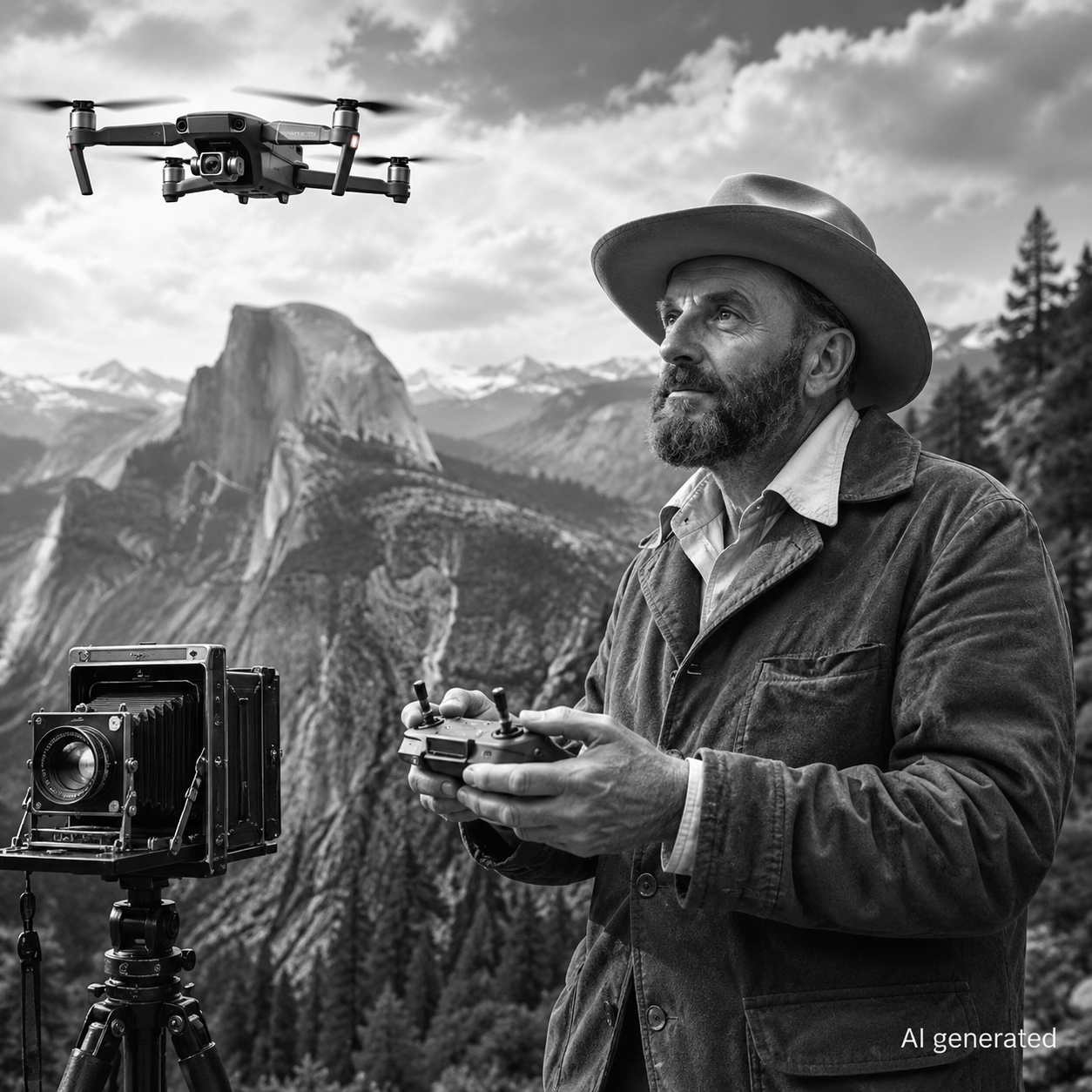
Whatever it is, the way you tell your story makes all the difference to only one person.
You!
It is often said that Ansel Adams was not only a master photographer, but also one of the great conservation photographers of his time.
Through his images, Adams gave millions of people a look at America's national parks, wilderness, mountains, valleys, and landscapes during an era when seeing those places wasn't as simple as pulling a phone out of your pocket.
There was no Instagram.
No Google Images.
No drone footage.
No 4K YouTube video waiting to take you through Yosemite from the comfort of your couch.
For many people, photographs were their window into these wild places.
And Ansel Adams helped open that window.
His photographs did more than document beautiful landscapes. They helped people understand that some places were worth protecting, not just for those alive at the time, but for generations that hadn't even been born yet.
But I've found myself wondering something.
What would Ansel Adams be doing if he were a photographer today?
And maybe the more interesting question is:
Would we even recognize his greatness?
The Master Had a Few Tricks Too
We sometimes talk about the great photographers of the past as though they simply walked into the wilderness, pointed a camera at a mountain, pushed the shutter button and created perfection.
That wasn't exactly how it worked.
Ansel Adams was a master in the darkroom as well as behind the camera.
He understood exposure, development, contrast, dodging, burning and printing at an extraordinary level. The negative wasn't necessarily the finished photograph. It was the beginning of what he envisioned the final image could become.
Sound familiar?
Today we have Lightroom, Photoshop, computational photography and now artificial intelligence.
The tools have changed.
The desire to turn what the camera captured into what the photographer felt hasn't.
Adams also worked with equipment that would make many modern photographers reconsider how badly they really wanted that sunrise.
Large-format cameras. Tripods. Film holders. Lenses. Cases. Equipment that had to be carried into places where there certainly wasn't a parking spot waiting next to the composition.
Think about that for a moment.
Today I can carry an incredible camera, multiple lenses and thousands of potential photographs on memory cards in a backpack.
Adams often had to travel with large, heavy equipment and a limited number of exposures.
Surely that restricted where he could go, how quickly he could react and even some of the perspectives available to him.
Yet somehow, the images never seemed to suffer.
Maybe that's part of the lesson.
Has Digital Photography Made It Too Easy?
This is where things get interesting.
Has the digital age dethroned the grandfather of American black-and-white landscape photography?
If Ansel Adams were a 25-year-old photographer starting today with a modern mirrorless camera, Photoshop and every other tool available to us, would we look at his work with the same sense of wonder?
Or would somebody scroll past one of his photographs and comment:
"That's AI."
We seem to have entered a strange time when an image can almost look too good.
Amazing light?
AI.
Perfect wildlife encounter?
AI.
Incredible detail?
Must be AI.
Colors don't look exactly like somebody else's cellphone picture?
Obviously fake.
Sometimes I wonder whether we've become so accustomed to seeing thousands of images every day that we've made extraordinary photography strangely ordinary.
And that raises another question.
Have modern cameras made photography too easy?
Or, more accurately:
Do we sometimes believe a photograph has more value simply because the photographer suffered more to get it?
My Elegant Trogon Didn't Require a 10-Mile Hike
I recently photographed an Elegant Trogon here in Arizona.
For birders and wildlife photographers, that's a special bird. People specifically travel to Arizona hoping to see and photograph one.
And my great wilderness expedition?
I got out of my vehicle, walked about 30 feet and found the bird.
That's it.
No 10-mile hike.
No scaling the side of a mountain.
No three-day expedition surviving on granola bars and questionable life decisions.
I didn't even have to fight off a black bear.
I'm being dramatic, of course, but you get my point.
Imagine another photographer has dreamed about photographing an Elegant Trogon for years. They finally get their opportunity after hiking miles into the mountains, carrying equipment through the Arizona heat and spending hours waiting for the bird to appear.
I walk 30 feet.
We both come home with a beautiful photograph.
Is their photograph somehow more valuable than mine because it was harder to get?
Maybe their story is different.
But does that automatically make their image better?
I don't think it does.
I still experienced that bird in its natural habitat.
I watched it.
I photographed it.
I remember the excitement of finding it.
And now I have a story that I genuinely enjoy telling whenever someone asks me about that photograph.
That's part of photography for me.
The image and the experience become connected.
The Camera Doesn't Create the Connection
Modern equipment absolutely makes certain parts of photography easier.
Autofocus can lock onto the eye of a bird flying through a tree.
Cameras can shoot an incredible number of frames per second.
ISO performance lets us photograph in conditions that would have been extremely difficult generations ago.
We can instantly check exposure.
We can carry thousands of images on something smaller than a postage stamp.
And when we get home, the modern digital darkroom gives us tools Ansel Adams probably couldn't have imagined.
But here's the catch.
None of those tools can make somebody care about your photograph.
A camera can help you capture a technically perfect image.
It cannot guarantee an unforgettable one.
That's a very different thing.
So Give Ansel Adams a Modern Camera
This brings me back to my original question.
What happens if we hand Ansel Adams a modern digital camera?
Give him incredible dynamic range.
Give him today's lenses.
Give him autofocus.
Give him a drone.
Give him Lightroom and Photoshop.
Give him the ability to immediately see what he captured.
And yes, give him the same emerging AI tools the rest of us are now trying to figure out.
Would those tools somehow diminish what made him Ansel Adams?
I believe the opposite would happen.
I think we'd better buckle up.
Because the technology was never the most important part of what made his photographs special.
His vision was.
His understanding of light was.
His patience was.
His ability to recognize a composition was.
And perhaps most importantly, his ability to make people feel something about a place was.
Put today's technology into the hands of someone with that kind of vision and I don't believe we'd get a lesser Ansel Adams.
I think we'd see a level of expression we may never have been able to experience during his lifetime.
And I suspect he'd use those tools for exactly what he was already trying to accomplish: showing people the beauty and importance of wild places.
Maybe We Are Asking the Wrong Question
Maybe the question isn't whether digital photography has made things too easy.
Maybe it isn't whether Photoshop is cheating.
Maybe it isn't whether walking 30 feet to photograph a bird is somehow less respectable than hiking 10 miles to find the same one.
Maybe the question is much simpler:
Did the photograph make you stop?
Did you look at it for more than two seconds?
Did it make you curious?
Did it make you want to know the story?
Did it make you care about the animal or the place?
And most importantly, did it make you feel something?
Because cameras will continue to change.
Editing will continue to change.
Artificial intelligence will change photography in ways we're only beginning to understand.
Twenty years from now, photographers may look at the equipment we're carrying today and wonder how we managed to create anything with such primitive technology.
But I don't believe the purpose of photography changes with it.
We aren't supposed to prove how difficult it was to push the shutter button.
We're trying to create something worth remembering.
Ansel Adams did that.
Decades later, people still recognize his photographs. They still discuss them. They still hang them on walls. They still feel something when they see them.
And perhaps that's the standard worth chasing.
Not whether the photographer carried 50 pounds of equipment.
Not whether the image came from film or a digital sensor.
Not whether the photographer hiked 10 miles or walked 30 feet from the car.
The real test is whether the image stays with you.
Because the best photographs don't just show you what was standing in front of the camera.
They leave you with a little piece of what the photographer felt while standing behind it.
And no matter how sophisticated our cameras become, that part still has to come from us.
John A. Smith
The Rusty Shutter